-
1C
-
Agda
-
Agile/Scrum
-
Alef
-
APL
-
Assembler
-
AWK
-
Basic
-
Beta Programming Language
-
Big Data/DataScience
-
C
-
C#
-
C++
-
Cobol
-
Crystal
-
CSS
-
D
-
Dart
-
DataBase (SQL)
-
Delphi
-
F#
-
Flutter
-
Fortran
-
GameDev
-
Git
-
Go (Golang)
-
GPT/AI/ИИ
-
Hacking and Security
-
Haskell
-
HTML
-
Java
-
JavaScript (JS)
-
Julia
-
Kotlin
-
Machine Learning (ML)
-
Natural language processing (NLP)
-
.NET (.NET Core)
-
Pascal
-
PHP
-
Python
-
R
-
Ruby
-
Rust
-
Scratch
-
Swift
-
UML
-
UX/UI
-
Visual Basic
-
Wolfram
-
XML
-
АСУ
-
Проектирование/System Design
-
Сети/Network
-
Статьи
-
Схемотехника/электронные схемы
-
1C
-
Agda
-
Agile/Scrum
-
Alef
-
APL
-
Assembler
-
AWK
-
Basic
-
Beta Programming Language
-
Big Data/DataScience
-
C
-
C#
-
C++
-
Cobol
-
Crystal
-
CSS
-
D
-
Dart
-
DataBase (SQL)
-
Delphi
-
F#
-
Flutter
-
Fortran
-
GameDev
-
Git
-
Go (Golang)
-
GPT/AI/ИИ
-
Hacking and Security
-
Haskell
-
HTML
-
Java
-
JavaScript (JS)
-
Julia
-
Kotlin
-
Machine Learning (ML)
-
Natural language processing (NLP)
-
.NET (.NET Core)
-
Pascal
-
PHP
-
Python
-
R
-
Ruby
-
Rust
-
Scratch
-
Swift
-
UML
-
UX/UI
-
Visual Basic
-
Wolfram
-
XML
-
АСУ
-
Проектирование/System Design
-
Сети/Network
-
Статьи
-
Схемотехника/электронные схемы
Меню
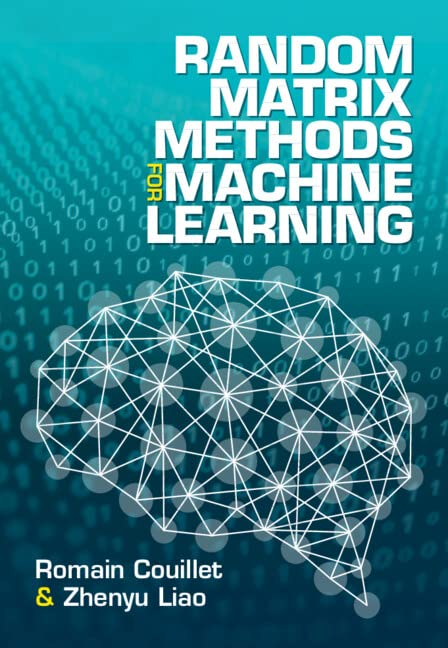
Random Matrix Methods for Machine Learning
Автор: Couillet Romain , Liao Zhenyu
Дата выхода: 2022
Издательство: Cambridge University Press
Количество страниц: 411
Размер файла: 4,0 МБ
Тип файла: PDF
Добавил: codelibs
Проверить на вирусы0.0 9781009123235....1
01.0_pp_i_iv_Frontmatter....2
02.0_pp_v_vi_Contents....6
03.0_pp_vii_viii_Preface....8
04.0_pp_1_34_Introduction....10
05.0_pp_35_154_Random_Matrix_Theory....44
06.0_pp_155_206_Statistical_Inference_in_Linear_Models....164
07.0_pp_207_276_Kernel_Methods....216
08.0_pp_277_312_Large_Neural_Networks....286
09.0_pp_313_336_Large-Dimensional_Convex_Optimization....322
10.0_pp_337_363_Community_Detection_on_Graphs....346
11.0_pp_364_377_Community_Detection_on_Graphs....373
12.0_pp_378_400_Bibliography....387
13.0_pp_401_402_Index....410
This book presents a unified theory of random matrices for applications in machine learning, offering a large-dimensional data vision that exploits concentration and universality phenomena. This enables a precise understanding, and possible improvements, of the core mechanisms at play in real-world machine learning algorithms. The book opens with a thorough introduction to the theoretical basics of random matrices, which serves as a support to a wide scope of applications ranging from SVMs, through semi-supervised learning, unsupervised spectral clustering, and graph methods, to neural networks and deep learning. For each application, the authors discuss small- versus large-dimensional intuitions of the problem, followed by a systematic random matrix analysis of the resulting performance and possible improvements. All concepts, applications, and variations are illustrated numerically on synthetic as well as real-world data, with MATLAB and Python code provided on the accompanying website.


