-
1C
-
Agda
-
Agile/Scrum
-
Alef
-
APL
-
Assembler
-
AWK
-
Basic
-
Beta Programming Language
-
Big Data/DataScience
-
C
-
C#
-
C++
-
Cobol
-
Crystal
-
CSS
-
D
-
Dart
-
DataBase (SQL)
-
Delphi
-
F#
-
Flutter
-
Fortran
-
GameDev
-
Git
-
Go (Golang)
-
GPT/AI/ИИ
-
Hacking and Security
-
Haskell
-
HTML
-
Java
-
JavaScript (JS)
-
Julia
-
Kotlin
-
Machine Learning (ML)
-
Natural language processing (NLP)
-
.NET (.NET Core)
-
Pascal
-
PHP
-
Python
-
R
-
Ruby
-
Rust
-
Scratch
-
Swift
-
UML
-
UX/UI
-
Visual Basic
-
Wolfram
-
XML
-
АСУ
-
Проектирование/System Design
-
Сети/Network
-
Статьи
-
Схемотехника/электронные схемы
-
1C
-
Agda
-
Agile/Scrum
-
Alef
-
APL
-
Assembler
-
AWK
-
Basic
-
Beta Programming Language
-
Big Data/DataScience
-
C
-
C#
-
C++
-
Cobol
-
Crystal
-
CSS
-
D
-
Dart
-
DataBase (SQL)
-
Delphi
-
F#
-
Flutter
-
Fortran
-
GameDev
-
Git
-
Go (Golang)
-
GPT/AI/ИИ
-
Hacking and Security
-
Haskell
-
HTML
-
Java
-
JavaScript (JS)
-
Julia
-
Kotlin
-
Machine Learning (ML)
-
Natural language processing (NLP)
-
.NET (.NET Core)
-
Pascal
-
PHP
-
Python
-
R
-
Ruby
-
Rust
-
Scratch
-
Swift
-
UML
-
UX/UI
-
Visual Basic
-
Wolfram
-
XML
-
АСУ
-
Проектирование/System Design
-
Сети/Network
-
Статьи
-
Схемотехника/электронные схемы
Меню
Python for Microcontrollers: Getting Started with MicroPython
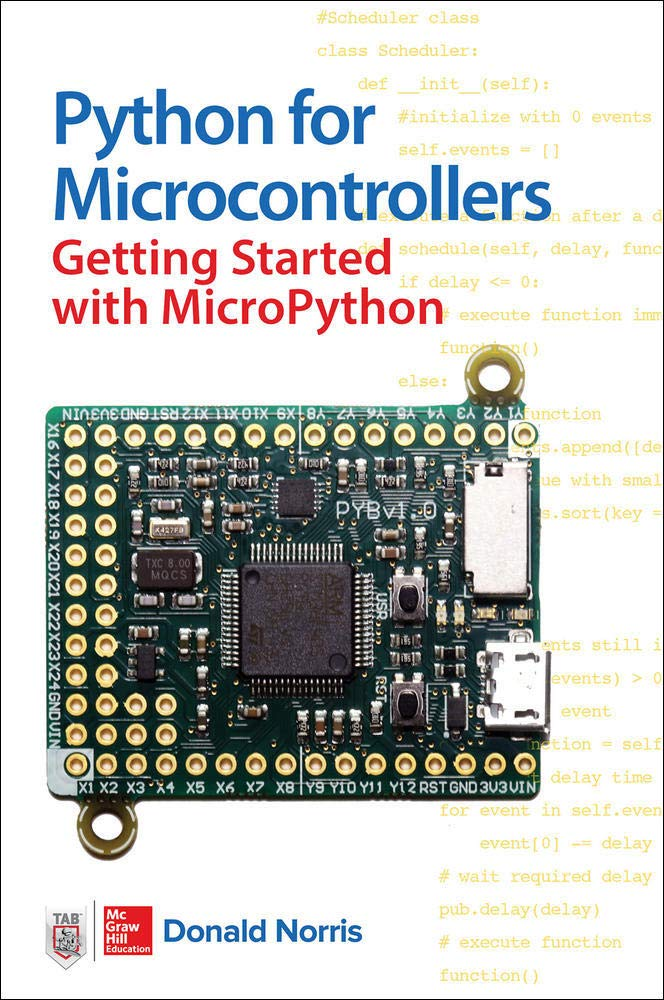
Автор: Norris Donald
Дата выхода: 2017
Издательство: McGraw-Hill Education
Количество страниц: 364
Размер файла: 10,1 МБ
Тип файла: PDF
Добавил: codelibs
Проверить на вирусыForeword
Preface
Conventions Used in This Book
Using Code Examples
O’Reilly Safari
How to Contact Us
Acknowledgments
1. What Is MicroPython?
Why Micro?
Why Python?
MicroPython Genesis
Dive In!
2. PyBoard
The Hardware
Developer Setup
3. BBC micro:bit
The Hardware
Developer Setup
4. Adafruit Circuit Playground Express
The Hardware
Developer Setup
5. ESP8266 / ESP32
The Hardware
Developer Setup
ESP8266
ESP32
6. Thinking Embedded
Human Drives
Abilities of Enchantment
Steps on the Ladder of Enchantment
7. Visual Feedback
Blinkenlights
NeoPixels (Blinkenlights on Steroids)
Text, Images, and Animation
PyBoard Colour LCD Display
8. Input and Sensing
Buttons and Capacitative Touch
Accelerometers, Gestures, and Compasses
Sound, Light, and Temperature
Sensing with Peripherals
9. GPIO
Pins
UART
SPI
I2C
Miscellaneous GPIO Techniques and Protocols
10. Networking
Circuit Playground Express Infrared
The micro:bit Radio
ESP8266/32 WiFi
MQTT
11. Sound and Music
Bleeps and Bloops
Music
Speech
12. Robots
Trundle Bot
Racer Bot
13. Idiomatic MicroPython
The Zen of MicroPython
Memory
Performance
14. Next Steps
The Community
Going Deeper
Index
Program Your Own MicroPython projects with ease―no prior programming experience necessary!
This DIY guide provides a practical introduction to microcontroller programming with MicroPython. Written by an experienced electronics hobbyist, Python for Microcontrollers: Getting Started with MicroPython features eight start-to-finish projects that clearly demonstrate each technique. You will learn how to use sensors, store data, control motors and other devices, and work with expansion boards. From there, you’ll discover how to design, build, and program all kinds of entertaining and practical projects of your own.
- Learn MicroPython and object-oriented programming basics
- Explore the powerful features of the Pyboard, ESP8266, and WiPy
- Interface with a PC and load files, programs, and modules
- Work with the LEDs, timers, and converters
- Control external devices using serial interfaces and PWM
- Build and program a let ball detector using the 3-axis accelerometer
- Install and program LCD and touchsensor expansion boards
- Record and play sounds using the AMP audio board


Плюсы: Хорошее объяснение фундаментальных принципов (ООП, прерывания, I2C, UART), интересные проекты (робот, детектор ударов в теннисе) и разбор работы с периферией на низком уровне.
Минусы: Книга безнадёжно устарела (версия MicroPython 1.8.2, плата Pyboard v1.1). Примеры содержат опечатки и синтаксические ошибки. Ориентация на редкое железо (AMP skin и пр.) снижает практическую ценность сегодня.
Вердикт: Полезна только опытным разработчикам для понимания «археологии» и концепций. Новичкам и тем, кто работает на современном ESP32/RP2040 — искать актуальные материалы.