-
1C
-
Agda
-
Agile/Scrum
-
Alef
-
APL
-
Assembler
-
AWK
-
Basic
-
Beta Programming Language
-
Big Data/DataScience
-
C
-
C#
-
C++
-
Cobol
-
Crystal
-
CSS
-
D
-
Dart
-
DataBase (SQL)
-
Delphi
-
F#
-
Flutter
-
Fortran
-
GameDev
-
Git
-
Go (Golang)
-
GPT/AI/ИИ
-
Hacking and Security
-
Haskell
-
HTML
-
Java
-
JavaScript (JS)
-
Julia
-
Kotlin
-
Machine Learning (ML)
-
Natural language processing (NLP)
-
.NET (.NET Core)
-
Pascal
-
PHP
-
Python
-
R
-
Ruby
-
Rust
-
Scratch
-
Swift
-
UML
-
UX/UI
-
Visual Basic
-
Wolfram
-
XML
-
АСУ
-
Проектирование/System Design
-
Сети/Network
-
Статьи
-
Схемотехника/электронные схемы
-
1C
-
Agda
-
Agile/Scrum
-
Alef
-
APL
-
Assembler
-
AWK
-
Basic
-
Beta Programming Language
-
Big Data/DataScience
-
C
-
C#
-
C++
-
Cobol
-
Crystal
-
CSS
-
D
-
Dart
-
DataBase (SQL)
-
Delphi
-
F#
-
Flutter
-
Fortran
-
GameDev
-
Git
-
Go (Golang)
-
GPT/AI/ИИ
-
Hacking and Security
-
Haskell
-
HTML
-
Java
-
JavaScript (JS)
-
Julia
-
Kotlin
-
Machine Learning (ML)
-
Natural language processing (NLP)
-
.NET (.NET Core)
-
Pascal
-
PHP
-
Python
-
R
-
Ruby
-
Rust
-
Scratch
-
Swift
-
UML
-
UX/UI
-
Visual Basic
-
Wolfram
-
XML
-
АСУ
-
Проектирование/System Design
-
Сети/Network
-
Статьи
-
Схемотехника/электронные схемы
Меню
Microservices with Go: Building scalable and reliable microservices with Go
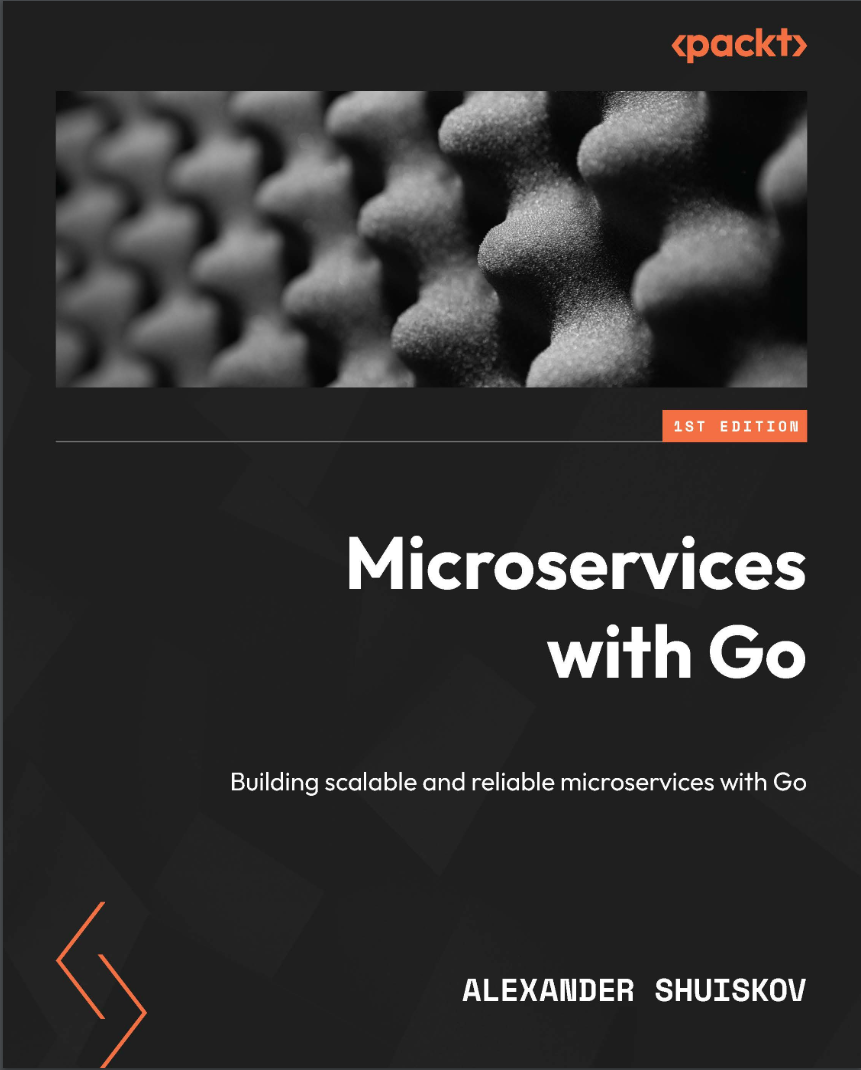
Автор: Shuiskov Alexander
Дата выхода: 2022
Издательство: Packt Publishing Limited
Количество страниц: 329
Размер файла: 2,0 МБ
Тип файла: PDF
Добавил: codelibs
Проверить на вирусы Дополнительные материалыCover....1
Title Page....2
Copyright and Credits....3
Contributors....5
Table of Contents....8
Preface....14
Part 1: Introduction....22
Chapter 1: Introduction to Microservices....24
What is a microservice?....24
Motivation to use microservices....25
Pros and cons of microservices....27
Benefits of microservices....27
Common issues of microservices....29
When to use microservice architecture....30
Role of Go in microservice development....31
Summary....32
Further reading....32
Part 2: Foundation....34
Chapter 2: Scaffolding a Go Microservice....36
Technical requirements....36
Go basics....37
Core principles....37
Writing idiomatic Go code....38
Interfaces....40
Tests....41
Context....41
Project structure....42
Private packages....42
Public packages....43
Executable packages....43
Other commonly used directories....43
Common files....43
Best practices....44
Scaffolding an example application....44
Movie application....45
Application code structure....48
Movie metadata service....50
Movie service....65
Summary....75
Further reading....76
Chapter 3: Service Discovery....78
Technical requirements....78
Service discovery overview....78
Registry....80
Service discovery models....81
Service health monitoring....82
Service discovery solutions....82
HashiCorp Consul....83
Kubernetes....83
Adopting service discovery....83
Preparing the application....84
Implementing the discovery logic....87
Using the discovery logic....93
Summary....99
Further reading....99
Chapter 4: Serialization....100
Technical requirements....100
The basics of serialization....101
Popular serialization formats....103
Using Protocol Buffers....107
Best practices for serialization....113
Summary....114
Further reading....114
Chapter 5: Synchronous Communication....116
Technical requirements....116
Introduction to synchronous communication....117
Go RPC frameworks and libraries....118
Defining a service API using Protocol Buffers....119
Implementing gateways and clients....123
Metadata service....123
Rating service....128
Movie service....130
Summary....136
Further reading....136
Chapter 6: Asynchronous Communication....138
Technical requirements....138
Asynchronous communication basics....138
Benefits and challenges of asynchronous communication....139
Techniques and patterns of asynchronous communication....141
Using Apache Kafka for messaging....143
Adopting Kafka for our microservices....145
Asynchronous communication best practices....153
Versioning....153
Leveraging partitioning....154
Summary....155
Further reading....155
Chapter 7: Storing Service Data....156
Technical requirements....156
Introduction to database....157
Using MySQL to store our service data....160
Summary....168
Further reading....169
Chapter 8: Deployment with Kubernetes....170
Technical requirements....170
Preparing application code for deployments....171
Deployment basics....171
Application configuration....172
Deploying via Kubernetes....174
Introduction to Kubernetes....175
Setting up our microservices for Kubernetes deployments....176
Deployment best practices....181
Automated rollbacks....182
Canary deployments....182
Replace with Continuous Deployment (CD)....183
Summary....183
Further reading....184
Chapter 9: Unit and Integration Testing....186
Technical requirements....186
Go testing overview....187
Unit tests....191
Mocking....193
Implementing unit tests....196
Integration tests....198
Testing best practices....210
Using helpful messages....210
Avoiding the use of Fatal in your logs....211
Making a comparison using a cmp library....212
Summary....213
Further reading....213
Part 3: Maintenance....214
Chapter 10: Reliability Overview....216
Technical requirements....216
Reliability basics....217
Achieving reliability through automation....218
Communication error handling....218
Graceful shutdown....228
Achieving reliability through development processes and culture....231
On-call process....231
Incident management....233
Reliability drills....235
Summary....236
Further reading....236
Chapter 11: Collecting Service Telemetry Data....238
Technical requirements....238
Telemetry overview....239
Collecting service logs....240
Choosing the logging library....243
Using logging features....244
Storing microservice logs....247
Logging best practices....248
Collecting service metrics....252
Storing metrics....254
Popular Go metrics libraries....256
Emitting service metrics....256
Metrics best practices....259
Tracing....260
Tracing tools....262
Collecting tracing data with the OpenTelemetry SDK....263
Summary....272
Further reading....273
Chapter 12: Setting Up Service Alerting....274
Technical requirements....274
Alerting basics....275
Alerting use cases....276
Introduction to Prometheus....277
Setting up Prometheus alerting for our microservices....280
Alerting best practices....288
Summary....289
Further reading....289
Chapter 13: Advanced Topics....290
Technical requirements....290
Profiling Go services....291
Creating microservice dashboards....295
Frameworks....301
Storing microservice ownership data....303
Securing microservice communication with JWT....305
JWT basics....306
Implementing authentication and authorization with JWTs....307
Summary....312
Further reading....312
Index....314
Other Books You May Enjoy....324
This book covers the key benefits and common issues of microservices, helping you understand the problems microservice architecture helps to solve, the issues it usually introduces, and the ways to tackle them.
You'll start by learning about the importance of using the right principles and standards in order to achieve the key benefits of microservice architecture. The following chapters will explain why the Go programming language is one of the most popular languages for microservice development and lay down the foundations for the next chapters of the book. You'll explore the foundational aspects of Go microservice development including service scaffolding, service discovery, data serialization, synchronous and asynchronous communication, deployment, and testing. After covering the development aspects, you'll progress to maintenance and reliability topics. The last part focuses on more advanced topics of Go microservice development including system reliability, observability, maintainability, and scalability. In this part, you'll dive into the best practices and examples which illustrate how to apply the key ideas to existing applications, using the services scaffolded in the previous part as examples.
By the end of this book, you'll have gained hands-on experience with everything you need to develop scalable, reliable and performant microservices using Go.
What you will learn
- Get familiar with the industry's best practices and solutions in microservice development
- Understand service discovery in the microservices environment
- Explore reliability and observability principles
- Discover best practices for asynchronous communication
- Focus on how to write high-quality unit and integration tests in Go applications
- Understand how to profile Go microservices
Who this book is for
This book is for all types of developers, from people interested in learning how to write microservices in Go to seasoned professionals who want to take the next step in mastering the art of writing scalable and reliable microservice-based systems. A basic understanding of Go will come in handy.


