-
1C
-
Agda
-
Agile/Scrum
-
Alef
-
APL
-
Assembler
-
AWK
-
Basic
-
Beta Programming Language
-
Big Data/DataScience
-
C
-
C#
-
C++
-
Cobol
-
Crystal
-
CSS
-
D
-
Dart
-
DataBase (SQL)
-
Delphi
-
F#
-
Flutter
-
Fortran
-
GameDev
-
Git
-
Go (Golang)
-
GPT/AI/ИИ
-
Hacking and Security
-
Haskell
-
HTML
-
Java
-
JavaScript (JS)
-
Julia
-
Kotlin
-
Machine Learning (ML)
-
Natural language processing (NLP)
-
.NET (.NET Core)
-
Pascal
-
PHP
-
Python
-
R
-
Ruby
-
Rust
-
Scratch
-
Swift
-
UML
-
UX/UI
-
Visual Basic
-
Wolfram
-
XML
-
АСУ
-
Проектирование/System Design
-
Сети/Network
-
Статьи
-
Схемотехника/электронные схемы
-
1C
-
Agda
-
Agile/Scrum
-
Alef
-
APL
-
Assembler
-
AWK
-
Basic
-
Beta Programming Language
-
Big Data/DataScience
-
C
-
C#
-
C++
-
Cobol
-
Crystal
-
CSS
-
D
-
Dart
-
DataBase (SQL)
-
Delphi
-
F#
-
Flutter
-
Fortran
-
GameDev
-
Git
-
Go (Golang)
-
GPT/AI/ИИ
-
Hacking and Security
-
Haskell
-
HTML
-
Java
-
JavaScript (JS)
-
Julia
-
Kotlin
-
Machine Learning (ML)
-
Natural language processing (NLP)
-
.NET (.NET Core)
-
Pascal
-
PHP
-
Python
-
R
-
Ruby
-
Rust
-
Scratch
-
Swift
-
UML
-
UX/UI
-
Visual Basic
-
Wolfram
-
XML
-
АСУ
-
Проектирование/System Design
-
Сети/Network
-
Статьи
-
Схемотехника/электронные схемы
Меню
ISTQB® Certified Tester Foundation Level: A Self-Study Guide Syllabus v4.0
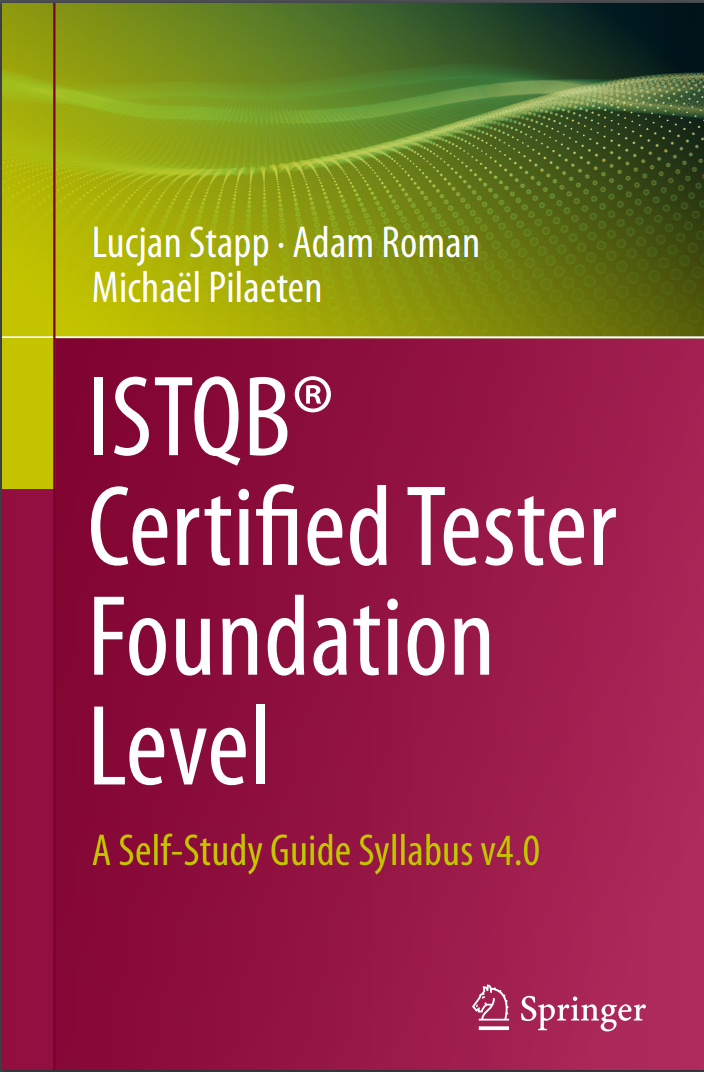
Автор: Pilaeten Michaël , Roman Adam , Stapp Lucjan
Дата выхода: 2023
Издательство: Springer Nature
Количество страниц: 409
Размер файла: 3,6 МБ
Тип файла: PDF
Добавил: codelibs
Проверить на вирусыPreface....5
Purpose of This Book....5
Book Structure....5
Part I: Certificate, Syllabus, and Foundation Level Exam....6
Part II: Discussion of the Content of the Syllabus....6
Part III: Answers to Questions and Exercises....7
Part IV: Official Sample Exam and Additional Questions....7
Contents....8
About the Authors....12
List of Abbreviations....14
Part I: Certification, Syllabus, and Foundation Level Exam....16
Foundation Level Certificate....17
History of the Foundation Level Certificate....17
Career Paths for Testers....18
Target Audience....19
Objectives of the International Qualification System....19
Foundation Level Syllabus....21
Business Outcomes....21
Learning Objectives and K-Levels....21
Requirements for Candidates....23
References to Norms and Standards....23
Continuous Update....24
Release Notes for Foundation Level Syllabus v4.0....24
Content of the Syllabus....25
Chapter 1. Fundamentals of Testing....25
Learning Objectives....25
Chapter 2. Testing Throughout the Software Development Life Cycle....26
Learning Objectives....26
Chapter 3. Static Testing....27
Learning Objectives....27
Chapter 4. Test Analysis and Design....27
Learning Objectives....27
Chapter 5. Managing the Test Activities....28
Learning Objectives....28
Chapter 6. Test Tools....29
Learning Objectives....29
Foundation Level Exam....30
Structure of the Exam....30
Exam Rules....30
Distribution of Questions....31
Tips: Before and During the Exam....33
Part II: The Syllabus Content....35
Chapter 1 Fundamentals of Testing....36
1.1 What Is Testing?....38
1.1.1 Test Objectives....39
1.1.2 Testing and Debugging....40
1.2 Why Is Testing Necessary?....42
1.2.1 Testing´s Contribution to Success....45
1.2.2 Testing and Quality Assurance (QA)....46
1.2.3 Errors, Defects, Failures, and Root Causes....47
1.3 Testing Principles....52
1.4 Test Activities, Testware, and Test Roles....58
1.4.1 Test Activities and Tasks....58
1.4.2 Test Process in Context....64
1.4.3 Testware....65
1.4.4 Traceability Between the Test Basis and Testware....71
1.4.5 Roles in Testing....72
1.5 Essential Skills and Good Practices in Testing....75
1.5.1 Generic Skills Required for Testing....75
1.5.2 Whole Team Approach....77
1.5.3 Independence of Testing....78
Sample Questions....80
Chapter 2 Testing Throughout the Software Development Life Cycle....85
2.1 Testing in the Context of a Software Development Cycle....86
2.1.1 Impact of the Software Development Life Cycle on Testing....87
Sequential Models....89
Iterative and Incremental Models....91
Development Methodologies and Agile Practices....93
2.1.2 Software Development Life Cycle and Good Testing Practices....97
2.1.3 Testing as a Driver for Software Development....97
2.1.4 DevOps and Testing....102
2.1.5 Shift-Left Approach....106
2.1.6 Retrospectives and Process Improvement....107
2.2 Test Levels and Test Types....109
2.2.1 Test Levels....109
2.2.1.1 Component Testing....110
2.2.1.2 Component Integration Testing and System Integration Testing....113
2.2.1.3 System Testing....117
2.2.1.4 Acceptance Testing....120
2.2.2 Test Types....125
2.2.2.1 Functional Testing....125
2.2.2.2 Nonfunctional Testing....127
2.2.2.3 White-Box Testing....130
2.2.2.4 Black-Box Testing....132
2.2.2.5 Test Levels vs. Test Types....132
2.2.3 Confirmation Testing and Regression Testing....134
2.3 Maintenance Testing....137
Sample Questions....140
Chapter 3 Static Testing....143
3.1 Static Testing Basics....144
3.1.1 Work Products Examinable by Static Testing....145
3.1.2 Value of Static Testing....146
3.1.3 Differences Between Static Testing and Dynamic Testing....150
3.2 Feedback and Review Process....153
3.2.1 Benefits of Early and Frequent Stakeholder Feedback....153
3.2.2 Review Process Activities....154
3.2.3 Roles and Responsibilities in Reviews....160
3.2.4 Review Types....161
3.2.5 Success Factors for Reviews....170
3.2.6 (*) Review Techniques....172
Sample Questions....175
Chapter 4 Test Analysis and Design....179
4.1 Test Techniques Overview....181
4.2 Black-Box Test Techniques....186
4.2.1 Equivalence Partitioning (EP)....187
4.2.2 Boundary Value Analysis (BVA)....197
4.2.3 Decision Table Testing....204
4.2.4 State Transition Testing....209
4.2.5 (*) Use Case Testing....218
4.3 White-Box Test Techniques....221
4.3.1 Statement Testing and Statement Coverage....222
4.3.2 Branch Testing and Branch Coverage....224
4.3.3 The Value of White-Box Testing....227
4.4 Experience-Based Test Techniques....229
4.4.1 Error Guessing....230
4.4.2 Exploratory Testing....233
4.4.3 Checklist-Based Testing....236
4.5 Collaboration-Based Test Approaches....239
4.5.1 Collaborative User Story Writing....239
4.5.2 Acceptance Criteria....242
4.5.3 Acceptance Test-Driven Development (ATDD)....244
Sample Questions....247
Exercises....255
Chapter 5 Managing the Test Activities....260
5.1 Test Planning....261
5.1.1 Purpose and Content of a Test Plan....262
5.1.2 Tester´s Contribution to Iteration and Release Planning....266
5.1.3 Entry Criteria and Exit Criteria....267
5.1.4 Estimation Techniques....268
5.1.5 Test Case Prioritization....277
5.1.6 Test Pyramid....284
5.1.7 Testing Quadrants....285
5.2 Risk Management....286
5.2.1 Risk Definition and Risk Attributes....288
5.2.2 Project Risks and Product Risks....288
5.2.3 Product Risk Analysis....290
5.2.4 Product Risk Control....293
5.3 Test Monitoring, Test Control, and Test Completion....295
5.3.1 Metrics Used in Testing....296
5.3.2 Purpose, Content, and Audience for Test Reports....297
5.3.3 Communicating the Status of Testing....300
5.4 Configuration Management....301
5.5 Defect Management....303
Sample Questions....305
Exercises for Chapter 5....311
Chapter 6 Test Tools....315
6.1 Tool Support for Testing....315
6.2 Benefits and Risks of Test Automation....317
Sample Questions....318
Part III: Answers to Questions and Exercises....319
Answers to Sample Questions....320
Answers to Questions from Chap. 1....320
Answers to Questions from Chap. 2....324
Answers to Questions from Chap. 3....328
Answers to Questions from Chap. 4....330
Answers to Questions from Chap. 5....339
Answers to Questions from Chap. 6....344
Solutions to Exercises....346
Solutions to Exercises from Chap. 4....346
Solutions to Exercises from Chap. 5....356
Part IV: Official Sample Exam....359
Exam Set A....360
Additional Sample Questions....374
Exam Set A: Answers....383
Additional Sample Questions-Answers....395
References....403
Index....406
This book is aimed at everyone preparing for the ISTQB® Certified Tester – Foundation Level exam based on the Foundation Level syllabus (version 4.0) published in 2023. It provides candidates with reliable knowledge based on this document and thus distinguishes itself from all the information about ISTQB® syllabi and exams on the Internet, which is often of rather poor quality and may even contain serious errors.
The book expands and details many issues that are described in the new 2023 version of the syllabus in a perfunctory or general way only. According to the ISTQB® guidelines for syllabus-based training, an exercise must be provided for each learning objective at the K3 level, and a practical example must be provided for each objective at the K2 or K3 level. In order to satisfy these requirements, the authors prepared numerous exercises and examples for all learning objectives at these levels. In addition, for each learning objective, one or more sample exam questions are presented which are similar to those that the candidate will see in the exam. This makes the book an excellent aid for studying and preparing for the exam and verifying acquired knowledge.


