-
1C
-
Agda
-
Agile/Scrum
-
Alef
-
APL
-
Assembler
-
AWK
-
Basic
-
Beta Programming Language
-
Big Data/DataScience
-
C
-
C#
-
C++
-
Cobol
-
Crystal
-
CSS
-
D
-
Dart
-
DataBase (SQL)
-
Delphi
-
F#
-
Flutter
-
Fortran
-
GameDev
-
Git
-
Go (Golang)
-
GPT/AI/ИИ
-
Hacking and Security
-
Haskell
-
HTML
-
Java
-
JavaScript (JS)
-
Julia
-
Kotlin
-
Machine Learning (ML)
-
Natural language processing (NLP)
-
.NET (.NET Core)
-
Pascal
-
PHP
-
Python
-
R
-
Ruby
-
Rust
-
Scratch
-
Swift
-
UML
-
UX/UI
-
Visual Basic
-
Wolfram
-
XML
-
АСУ
-
Проектирование/System Design
-
Сети/Network
-
Статьи
-
Схемотехника/электронные схемы
-
1C
-
Agda
-
Agile/Scrum
-
Alef
-
APL
-
Assembler
-
AWK
-
Basic
-
Beta Programming Language
-
Big Data/DataScience
-
C
-
C#
-
C++
-
Cobol
-
Crystal
-
CSS
-
D
-
Dart
-
DataBase (SQL)
-
Delphi
-
F#
-
Flutter
-
Fortran
-
GameDev
-
Git
-
Go (Golang)
-
GPT/AI/ИИ
-
Hacking and Security
-
Haskell
-
HTML
-
Java
-
JavaScript (JS)
-
Julia
-
Kotlin
-
Machine Learning (ML)
-
Natural language processing (NLP)
-
.NET (.NET Core)
-
Pascal
-
PHP
-
Python
-
R
-
Ruby
-
Rust
-
Scratch
-
Swift
-
UML
-
UX/UI
-
Visual Basic
-
Wolfram
-
XML
-
АСУ
-
Проектирование/System Design
-
Сети/Network
-
Статьи
-
Схемотехника/электронные схемы
Меню
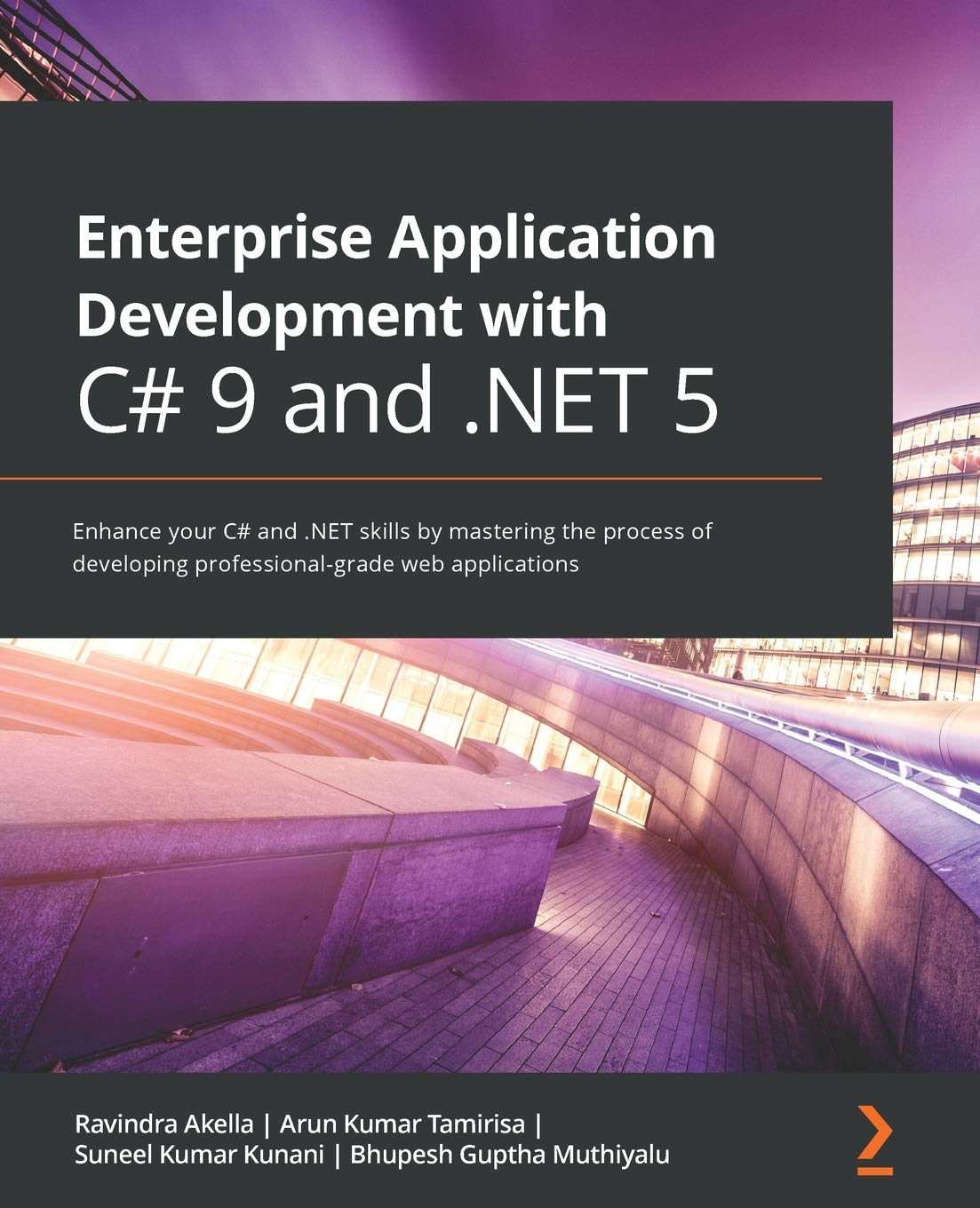
Enterprise Application Development with C# 9 and .NET 5: Enhance your C# and .NET skills by mastering the process of developing professional-grade web applications
Автор: Kunani Suneel Kumar , Muthiyalu Bhupesh Guptha , Ravindra Akella , Tamirisa Arun Kumar
Дата выхода: 2021
Издательство: Packt Publishing Limited
Количество страниц: 611
Размер файла: 6,9 МБ
Тип файла: PDF
Добавил: codelibs
Проверить на вирусы Дополнительные материалыCover....1
Title Page....2
Copyright and Credits....3
Dedication....4
Contributors....5
Table of Contents....8
Preface....18
Section 1: Architecting an Enterprise Application and its Fundamentals....24
Chapter 01: Designing and Architecting an Enterprise Application....26
Technical requirements....27
A primer on common design principles and patterns....27
Design principles....28
Design patterns....31
Understanding common enterprise architectures....35
Common issues with monolithic apps....36
Separation of concerns/single responsibility architecture ....37
Domain-driven architecture....38
Stateless services architecture....38
Event-driven architecture ....39
Data storage and access architecture....40
Resiliency architecture....40
Evolution and operations architecture....41
Identifying enterprise application requirements (business and technical)....42
The application's business requirements....43
The application's technical requirements....43
Architecting an enterprise application....45
Solution structuring for an enterprise application....49
Summary....50
Questions....50
Chapter 02: Introducing .NET 5 Core and Standard....52
Technical requirements....53
Introducing .NET 5....53
Understanding the core features....54
Understanding application frameworks....56
Understanding the core components of .NET....56
Setting up the development environment....58
Understanding the CLI....60
Overview of global.json ....62
What is .NET Standard?....63
Understanding the use of .NET 5 and .NET Standard....64
Understanding .NET 5 cross-platform and cloud application support....66
Cloud support....68
Summary....69
Questions....69
Further reading....70
Chapter 03: Introducing C# 9....72
Technical requirements....73
Understanding Init-only setters....73
Working with record types....74
The with expression....77
Understanding top-level statements....77
Examining objects with pattern matching....79
The constant pattern....79
Type patterns....80
Property patterns....80
Conjunctive and disjunctive patterns....80
Pattern matching with the switch expression....81
Tuple patterns....82
Understanding type inference with target-typed expressions....83
Understanding static anonymous functions....83
Eager initialization with module initializers....84
Summary....85
Questions....86
Section 2: Cross-Cutting Concerns....88
Chapter 04: Threading and Asynchronous Operations....90
Technical requirements....91
Understanding the jargon....91
Demystifying threads, lazy initialization, and ThreadPool....93
Working with System.Threading.Thread....94
ThreadPool....96
Lazy initialization....98
Understanding locks, semaphores, and SemaphoreSlim....103
The critical section and thread safety....103
Introducing locks....104
Mutex (Windows only)....105
Introducing semaphores and SemaphoreSlim....105
Choosing the right synchronization constructs....107
Introducing tasks and parallels....109
Introduction to Task and the TPL....109
Handling task exceptions....112
Implementing task cancellation....113
Implementing continuations....117
SynchronizationContext....119
TaskScheduler....119
Implementing data parallelism....120
Using Parallel LINQ (PLINQ)....122
Introducing async-await....126
The task-based asynchronous pattern....127
Principles of using async-await....129
Async streams with IAsyncEnumerable....135
Wrappers for legacy patterns....137
ThreadPool starvation....140
Using concurrent collections for parallelism....141
ConcurrentDictionary....141
Producer-consumer concurrent collections....146
The BlockingCollection class....151
Summary....153
Questions....154
Further reading....154
Chapter 05: Dependency Injection in .NET....156
Technical requirements....157
What is DI?....157
Types of DI....158
DI in ASP.NET Core 5....160
Understanding service lifetimes....162
Managing application services....171
DI in Razor Pages....176
Using third-party containers....177
Summary....181
Questions....182
Chapter 06: Configuration in .NET Core....184
Technical requirements....185
Understanding configuration....185
Default configuration....186
Adding configurations....189
Reading configurations....191
Leveraging built-in configuration providers....194
Azure Key Vault configuration provider....194
File configuration provider....205
Building a custom configuration provider....208
Configuration source....208
Configuration provider....209
Configuration extension....211
Summary ....213
Questions....214
Further reading....215
Chapter 07: Logging in .NET Core ....216
Technical requirements....217
Characteristics of good logging....217
Understanding the available logging providers....219
Built-in logging providers....220
Third-party logging providers....221
Working with Azure App Service....222
Enabling application logging in Azure App Service....223
Monitoring using metrics....229
Alerting using metrics....233
Real-time telemetry in Azure Application Insights....234
Enabling application logging in Application Insights....236
Creating a .NET 5 logging class library....242
Summary....246
Questions....247
Chapter 08: Understanding Caching....248
Technical requirements....249
Introduction to caching....249
Client caching....250
Content Delivery Network (CDN)....250
Web server caching....251
Database caching....251
Application caching....251
Understanding the components of caching....252
Response caching....252
Distributed caching....256
Cache access patterns....258
Caching platforms....261
In-memory cache....262
Distributed cache....265
Designing a cache abstraction layer using distributed caching....274
Caching considerations....277
Summary....278
Questions....279
Further reading....279
Section 3: Developing Your Enterprise Application....280
Chapter 09: Working with Data in .NET 5....282
Technical requirements....283
Introduction to data....283
Relational Database Management System (RDBMS)....284
NoSQL....285
Disks, files, and directories....286
Handling directories....287
Reading/writing data with streams, binary, and strings....290
Streams....290
Reader/writer....293
TextReader/TextWriter versus BinaryReader/BinaryWriter....297
JSON.NET....297
SQL, Azure Cosmos DB, and Azure Storage....298
SQL Server....299
Azure Cosmos DB....301
Azure Storage....309
Working with EF Core....314
Configuration and querying....314
Code first versus database first....321
Designing a Data access service using Azure Cosmos DB....323
Summary....330
Questions....331
Further reading....332
Chapter 10: Creating an ASP.NET Core 5 Web API....334
Technical requirements....335
Introduction to Representational State Transfer (REST)....335
The REST maturity model....338
Understanding the internals of an ASP.NET Core 5 web API....339
Program and Startup classes....342
Understanding middleware....347
Building a custom middleware....349
Handling requests using controllers and actions....355
Understanding ASP.NET Core routing....355
Attribute-based routing....358
The ControllerBase class, the ApiController attribute, and the ActionResult class....361
Integration with the data layer....363
Creating DTOs....366
Service class contracts....368
The mapper class using AutoMapper....368
HttpClient factory for service-to-service calls....370
Implementing service classes....372
Implementing action methods in the controller....374
Understanding gRPC....378
Building a gRPC server in .NET....379
Building a gRPC client in .NET....381
Testing gRPC services ....383
Summary....384
Questions....384
Further reading....385
Chapter 11: Creating an ASP.NET Core 5 Web Application ....386
Technical requirements....387
Introduction to frontend web development....387
Razor syntax....389
Exploring Razor Pages....391
Exploring the ASP.NET Core MVC website....394
Understanding single-page applications....396
Integrating APIs with the service layer....397
Creating the controller and actions....404
Creating a UI using ASP.NET Core MVC....408
Setting up AdminLTE, the Layout page, and views....410
Understanding Blazor....418
Summary....427
Questions....427
Further reading....428
Section 4: Security....430
Chapter 12: Understanding Authentication....432
Technical requirements....433
Understanding the elements of authentication in .NET 5....433
Introduction to ASP.NET Core Identity....435
Sample implementation....435
Scaffolding....440
Integration with external login providers....442
Understanding OAuth 2.0....443
Tokens....445
Authorization grant types....446
Introduction to Azure AD....447
Azure AD B2C setup....448
Integration of our e-commerce application to Azure AD B2C....460
Introduction to Windows Authentication....462
Understanding best practices to secure client and server applications....464
Summary....465
Questions....465
Further reading....466
Chapter 13: Understanding Authorization....468
Technical requirements....469
Back to a few basics....469
Understanding authorization....470
Simple authorization....471
Enabling authorization globally....472
Role-based authorization....473
Policy-based role authorization....475
Implementing role-based authorization....477
Claim-based authorization....481
Policy-based authorization....483
Requirements....484
Requirement handlers....484
Registering a policy....486
Custom authorization....487
Custom authorization attributes....489
Authorization in client and server applications....491
Assigning roles to users....494
User identity in views....495
Summary....495
Questions....496
Further reading....497
Section 5: Health Checks, Unit Testing, Deployment, and Diagnostics....498
Chapter 14: Health and Diagnostics....500
Technical requirements....501
Introducing health checks....501
The health check API in ASP.NET Core 5....502
Adding a health check endpoint....502
Monitoring dependent URIs....504
Building a custom health check ....506
Monitoring the application with Application Insights....511
Live Metrics....512
Usage analysis with Application Insights....513
Smart Detection....514
Application availability....514
Search....517
Logs....519
Snapshot Debugger....522
Performing remote debugging....528
Summary....529
Questions....529
Further reading....530
Chapter 15: Testing....532
Technical requirements....533
Introducing testing....533
Understanding unit testing....535
Unit testing in Visual Studio....535
Code coverage....542
Understanding functional testing....544
Automating functional test cases....544
Understanding load testing....548
Load testing with JMeter....548
Summary....553
Questions....553
Chapter 16: Deploying the Applications in Azure....556
Technical requirements....557
Introducing Azure DevOps....557
Boards....559
Repos....561
Pipelines....563
Test plans....563
Artifacts....564
Understanding the CI pipeline....564
Understanding the flow and components of a pipeline....565
Understanding the CD pipeline....569
Continuous deployment versus continuous delivery....570
Deploying an ASP.NET 5 application....571
Creating a pipeline for CI and CD....576
Summary....585
Questions....586
Further reading....587
Assessments....588
Chapter 1....588
Chapter 2....588
Chapter 3....588
Chapter 4....589
Chapter 5....589
Chapter 6....589
Chapter 7....589
Chapter 8....590
Chapter 9....590
Chapter 10....590
Chapter 11....590
Chapter 12....590
Chapter 13....591
Chapter 14....591
Chapter 15....591
Chapter 16....591
Why subscribe?....592
About Packt....592
Other Books You May Enjoy....593
Index....596
.NET Core is one of the most popular programming platforms in the world for an increasingly large community of developers thanks to its excellent cross-platform support. This book will show you how to confidently use the features of .NET 5 with C# 9 to build robust enterprise applications.
Throughout the book, you'll work on creating an enterprise app and adding a key component to the app with each chapter, before finally getting it ready for testing and deployment. You'll learn concepts relating to advanced data structures, the Entity Framework Core, parallel programming, and dependency injection. As you progress, you'll cover various authentication and authorization schemes provided by .NET Core to make your apps and APIs secure. Next, you'll build web apps using ASP.NET Core 5 and deploy them on the cloud while working with various cloud components using Azure. The book then shows you how to use the latest Microsoft Visual Studio 2019 and C# 9 to simplify developer tasks, and also explores tips and tricks in Visual Studio 2019 to improve your productivity. Later, you'll discover various testing techniques such as unit testing and performance testing as well as different methods to deploy enterprise apps.
By the end of this book, you'll be able to create enterprise apps using the powerful features of .NET 5 and deploy them on the cloud.
What You Will Learn
- Design enterprise apps by making the most of the latest features of .NET 5
- Discover different layers of an app, such as the data layer, API layer, and web layer
- Explore end-to-end architecture, implement an enterprise web app using .NET and C# 9, and deploy the app on Azure
- Focus on the core concepts of web application development such as dependency injection, caching, logging, configuration, and authentication, and implement them in .NET 5
- Integrate the new .NET 5 health and performance check APIs with your app
- Understand how .NET 5 works and contribute to the .NET 5 platform
Who this book is for
If you are a developer, architect, or senior programmer who wants to leverage the features of .NET 5 and the C# language, as well as grasp essential techniques to build your skills, then this C# .NET 5 book is for you. Beginner to intermediate-level knowledge of the .NET framework and C# programming is required to understand the concepts covered in this book more effectively.


