-
1C
-
Agda
-
Agile/Scrum
-
Alef
-
APL
-
Assembler
-
AWK
-
Basic
-
Beta Programming Language
-
Big Data/DataScience
-
C
-
C#
-
C++
-
Cobol
-
Crystal
-
CSS
-
D
-
Dart
-
DataBase (SQL)
-
Delphi
-
F#
-
Flutter
-
Fortran
-
GameDev
-
Git
-
Go (Golang)
-
GPT/AI/ИИ
-
Hacking and Security
-
Haskell
-
HTML
-
Java
-
JavaScript (JS)
-
Julia
-
Kotlin
-
Machine Learning (ML)
-
Natural language processing (NLP)
-
.NET (.NET Core)
-
Pascal
-
PHP
-
Python
-
R
-
Ruby
-
Rust
-
Scratch
-
Swift
-
UML
-
UX/UI
-
Visual Basic
-
Wolfram
-
XML
-
АСУ
-
Проектирование/System Design
-
Сети/Network
-
Статьи
-
Схемотехника/электронные схемы
-
1C
-
Agda
-
Agile/Scrum
-
Alef
-
APL
-
Assembler
-
AWK
-
Basic
-
Beta Programming Language
-
Big Data/DataScience
-
C
-
C#
-
C++
-
Cobol
-
Crystal
-
CSS
-
D
-
Dart
-
DataBase (SQL)
-
Delphi
-
F#
-
Flutter
-
Fortran
-
GameDev
-
Git
-
Go (Golang)
-
GPT/AI/ИИ
-
Hacking and Security
-
Haskell
-
HTML
-
Java
-
JavaScript (JS)
-
Julia
-
Kotlin
-
Machine Learning (ML)
-
Natural language processing (NLP)
-
.NET (.NET Core)
-
Pascal
-
PHP
-
Python
-
R
-
Ruby
-
Rust
-
Scratch
-
Swift
-
UML
-
UX/UI
-
Visual Basic
-
Wolfram
-
XML
-
АСУ
-
Проектирование/System Design
-
Сети/Network
-
Статьи
-
Схемотехника/электронные схемы
Меню
Designing Machine Learning Systems: An Iterative Process for Production-Ready Applications
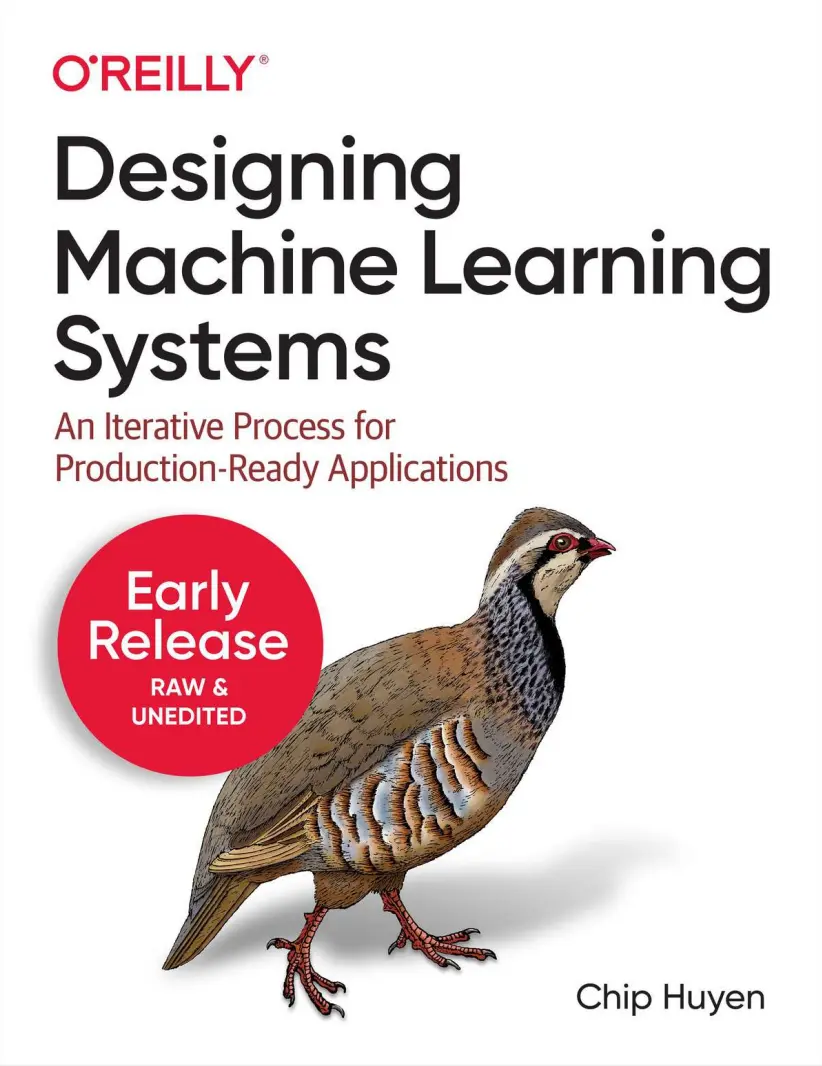
Автор: Huyen Chip
Дата выхода: 2022
Издательство: O’Reilly Media, Inc.
Количество страниц: 339
Размер файла: 3,8 МБ
Тип файла: PDF
Добавил: codelibs
Проверить на вирусы1. Machine Learning Systems in Production....5
When to Use Machine Learning....9
Machine Learning Use Cases....15
Understanding Machine Learning Systems....19
Mind vs. Data....19
Machine learning in research vs. in production....25
Machine learning systems vs. traditional software....39
Designing ML Systems in Production....42
Requirements for ML Systems....43
Iterative Process....46
Summary....50
2. Data Engineering Fundamentals....54
Data Sources....55
Data Formats....57
JSON....59
Row-major vs. Column-major Format....60
Text vs. Binary Format....64
Data Models....66
Relational Model....66
NoSQL....75
Structured vs. Unstructured Data....80
Data Storage Engines and Processing....83
Transactional and Analytical Processing....84
ETL: Extract, Transform, and Load....87
Modes of Dataflow....88
Data Passing Through Databases....88
Data Passing Through Services....89
Data Passing Through Real-time Transport....90
Batch Processing vs. Stream Processing....94
Summary....96
3. Training Data....99
Sampling....99
Non-Probability Sampling....100
Simple Random Sampling....101
Stratified Sampling....101
Weighted Sampling....101
Importance Sampling....102
Reservoir Sampling....102
Labeling....104
Hand Labels....105
Handling the Lack of Hand Labels....108
Class Imbalance....118
Challenges of Class Imbalance....119
Handling Class Imbalance....121
Data Augmentation....134
Simple Label-Preserving Transformations....135
Perturbation....138
Data Synthesis....139
Summary....141
4. Feature Engineering....143
Learned Features vs. Engineered Features....143
Common Feature Engineering Operations....147
Handling Missing Values....148
Scaling....152
Discretization....154
Encoding Categorical Features....155
Feature Crossing....157
Discrete and Continuous Positional Embeddings....159
Data Leakage....162
Common Causes for Data Leakage....163
Detecting Data Leakage....165
Engineering Good Features....166
Feature Importance....166
Feature Generalization....169
Summary....170
5. Model Development....172
Framing ML Problems....173
Types of ML Tasks....173
Objective Functions....181
Model Development and Training....184
Evaluating ML Models....184
Ensembles....193
Experiment Tracking and Versioning....205
Distributed Training....213
AutoML....219
Model Offline Evaluation....229
Baselines....230
Evaluation Methods....237
Summary....258
6. Model Deployment....261
Machine Learning Deployment Myths....265
Batch Prediction vs. Online Prediction....271
From Batch Prediction To Online Prediction....279
Unifying Batch Pipeline And Streaming Pipeline....282
Model Compression....285
Low-rank Factorization....286
Knowledge Distillation....287
Pruning....287
Quantization....288
ML on the Cloud and on the Edge....293
Compiling and Optimizing Models for Edge Devices....299
ML in Browsers....312
Summary....313
7. Why Machine Learning Systems Fail in Production....317
Natural Labels and Feedback Loop....317
Causes of ML System Failures....319
Production Data Differing From Training Data....320
Edge Cases....321
Degenerate Feedback Loop....323
Data Distribution Shifts....328
Types of Data Distribution Shifts....328
General Data Distribution Shifts....330
Handling Data Distribution Shifts....331
Summary....336
About the Author....339
Machine learning systems are both complex and unique. Complex because they consist of many different components and involve many different stakeholders. Unique because they're data dependent, with data varying wildly from one use case to the next. In this book, you'll learn a holistic approach to designing ML systems that are reliable, scalable, maintainable, and adaptive to changing environments and business requirements.
Author Chip Huyen, co-founder of Claypot AI, considers each design decision--such as how to process and create training data, which features to use, how often to retrain models, and what to monitor--in the context of how it can help your system as a whole achieve its objectives. The iterative framework in this book uses actual case studies backed by ample references.
This book will help you tackle scenarios such as:
- Engineering data and choosing the right metrics to solve a business problem
- Automating the process for continually developing, evaluating, deploying, and updating models
- Developing a monitoring system to quickly detect and address issues your models might encounter in production
- Architecting an ML platform that serves across use cases
- Developing responsible ML systems


