-
1C
-
Agda
-
Agile/Scrum
-
Alef
-
APL
-
Assembler
-
AWK
-
Basic
-
Beta Programming Language
-
Big Data/DataScience
-
C
-
C#
-
C++
-
Cobol
-
Crystal
-
CSS
-
D
-
Dart
-
DataBase (SQL)
-
Delphi
-
F#
-
Flutter
-
Fortran
-
GameDev
-
Git
-
Go (Golang)
-
GPT/AI/ИИ
-
Hacking and Security
-
Haskell
-
HTML
-
Java
-
JavaScript (JS)
-
Julia
-
Kotlin
-
Machine Learning (ML)
-
Natural language processing (NLP)
-
.NET (.NET Core)
-
Pascal
-
PHP
-
Python
-
R
-
Ruby
-
Rust
-
Scratch
-
Swift
-
UML
-
UX/UI
-
Visual Basic
-
Wolfram
-
XML
-
АСУ
-
Проектирование/System Design
-
Сети/Network
-
Статьи
-
Схемотехника/электронные схемы
-
1C
-
Agda
-
Agile/Scrum
-
Alef
-
APL
-
Assembler
-
AWK
-
Basic
-
Beta Programming Language
-
Big Data/DataScience
-
C
-
C#
-
C++
-
Cobol
-
Crystal
-
CSS
-
D
-
Dart
-
DataBase (SQL)
-
Delphi
-
F#
-
Flutter
-
Fortran
-
GameDev
-
Git
-
Go (Golang)
-
GPT/AI/ИИ
-
Hacking and Security
-
Haskell
-
HTML
-
Java
-
JavaScript (JS)
-
Julia
-
Kotlin
-
Machine Learning (ML)
-
Natural language processing (NLP)
-
.NET (.NET Core)
-
Pascal
-
PHP
-
Python
-
R
-
Ruby
-
Rust
-
Scratch
-
Swift
-
UML
-
UX/UI
-
Visual Basic
-
Wolfram
-
XML
-
АСУ
-
Проектирование/System Design
-
Сети/Network
-
Статьи
-
Схемотехника/электронные схемы
Меню
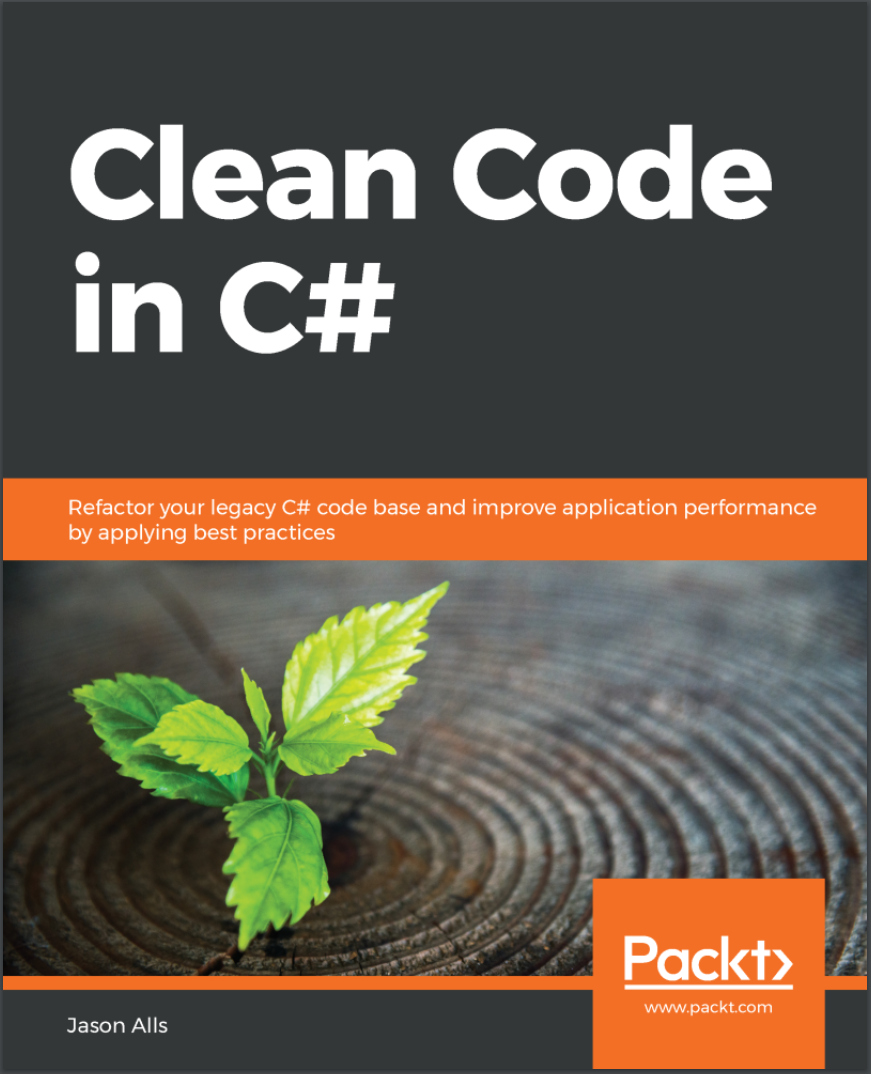
Clean Code in C#: Refactor your legacy C# code base and improve application performance by applying best practices
Автор: Alls Jason
Дата выхода: 2020
Издательство: Packt Publishing Limited
Количество страниц: 487
Размер файла: 6,0 МБ
Тип файла: PDF
Добавил: codelibs
Проверить на вирусы Дополнительные материалыCover....1
Title Page....2
Copyright and Credits....3
Dedication....4
About Packt....5
Contributors....6
Table of Contents....8
Preface....16
Chapter 1: Coding Standards and Principles in C#....22
Technical requirements....23
Good code versus bad code....24
Bad code....24
Improper indentation....25
Comments that state the obvious....25
Comments that excuse bad code....26
Commented-out lines of code....27
Improper organization of namespaces....27
Bad naming conventions....28
Classes that do multiple jobs....28
Methods that do many things....31
Methods with more than 10 lines of code....32
Methods with more than two parameters....33
Using exceptions to control program flow....33
Code that is difficult to read....34
Code that is tightly coupled....35
Low cohesion....36
Objects left hanging around....36
Use of the Finalize() method....37
Over-engineering....37
Learn to Keep It Simple, Stupid....37
Lack of regions in large classes....38
Lost-intention code....38
Directly exposing information....39
Good code....39
Proper indentation....40
Meaningful comments....40
API documentation comments....40
Proper organization using namespaces....41
Good naming conventions....41
Classes that only do one job....42
Methods that do one thing....42
Methods with less than 10 lines, and preferably no more than 4....42
Methods with no more than two parameters....43
Proper use of exceptions....43
Code that is readable....43
Code that is loosely coupled....44
High cohesion....44
Objects are cleanly disposed of....44
Avoiding the Finalize() method....45
The right level of abstraction....45
Using regions in large classes....46
The need for coding standards, principles, and methodologies....46
Coding standards....46
Coding principles....47
Coding methodologies....47
Coding conventions....48
Modularity....48
KISS....49
YAGNI....49
DRY....50
SOLID....50
Occam's Razor....51
Summary....51
Questions....52
Further reading....52
Chapter 2: Code Review – Process and Importance....53
The code review process....54
Preparing code for review....55
Leading a code review....56
Issuing a pull request....58
Responding to a pull request....61
Effects of feedback on reviewees....63
Knowing what to review....66
Company's coding guidelines and business requirement(s)....66
Naming conventions....66
Formatting....67
Testing....67
Architectural guidelines and design patterns....69
Performance and security....69
Knowing when to send code for review....70
Providing and responding to review feedback....72
Providing feedback as a reviewer....72
Responding to feedback as a reviewee....73
Summary....74
Questions....74
Further reading....75
Chapter 3: Classes, Objects, and Data Structures....76
Technical requirements....77
Organizing classes ....77
A class should have only one responsibility....80
Commenting for documentation generation....82
Cohesion and coupling....85
An example of tight coupling....86
An example of low coupling....87
An example of low cohesion....88
An example of high cohesion....89
Design for change....90
Interface-oriented programming....91
Dependency injection and inversion of control....94
An example of DI....94
An example of IoC....96
The Law of Demeter ....98
A good and a bad example (chaining) of the Law of Demeter....98
Immutable objects and data structures....100
An example of an immutable type....101
Objects should hide data and expose methods....102
An example of encapsulation....102
Data structures should expose data and have no methods....103
An example of data structure....104
Summary....104
Questions....105
Further reading....105
Chapter 4: Writing Clean Functions....106
Understanding functional programming....107
Keeping methods small....110
Indenting code....112
Avoiding duplication....114
Avoiding multiple parameters....115
Implementing SRP....117
Summary....122
Questions....122
Further reading....123
Chapter 5: Exception Handling....124
Checked and unchecked exceptions....125
Avoiding NullPointerExceptions....129
Business rule exceptions....132
Example 1 – handling conditions with business rule exceptions....135
Example 2 – handling conditions with normal program flow....136
Exceptions should provide meaningful information....138
Building your own custom exceptions....140
Summary....143
Questions....144
Further reading....144
Chapter 6: Unit Testing....145
Technical Requirements....146
Understanding the reasons for a good test....146
Understanding the testing tools....152
MSTest....152
NUnit....160
Moq....167
SpecFlow....172
TDD methodology practice – fail, pass, and refactor....177
Removing redundant tests, comments, and dead code....184
Summary....186
Questions....186
Further reading....187
Chapter 7: End-to-End System Testing....188
E2E testing....188
The login module (subsystem)....190
The admin module (subsystem)....194
The test module (subsystem)....196
Testing our three-module system using E2E....197
Factories....200
Dependency injection....209
Modularization....215
Summary....217
Questions....218
Further reading....218
Chapter 8: Threading and Concurrency....219
Understanding the thread life cycle....220
Adding thread parameters....222
Using a thread pool....223
Task Parallel Library....224
Parallel.Invoke()....224
Parallel.For()....225
ThreadPool.QueueUserWorkItem()....227
Using a mutex with synchronous threads....227
Working with parallel threads using semaphores....230
Limiting the number of processors and threads in the thread pool....232
Preventing deadlocks....234
Coding a deadlock example....235
Preventing race conditions....240
Understanding static constructors and methods ....243
Adding static constructors to our sample code....244
Adding static methods to our sample code....245
Mutability, immutability, and thread safety....249
Writing code that is mutable and not thread-safe....249
Writing code that is immutable and thread-safe ....251
Understanding thread safety....253
Synchronized method dependencies....257
Using the Interlocked class....258
General recommendations....262
Summary....263
Questions....264
Further reading....264
Chapter 9: Designing and Developing APIs....266
Technical requirements....267
What is an API?....267
API proxies....269
API design guidelines....271
Well-defined software boundaries....274
Understanding the importance of good quality API documentation ....276
Swagger API development....277
Passing immutable structs instead of mutable objects....280
Testing third-party APIs....283
Testing your own APIs....284
API design using RAML....286
Installing Atom and API Workbench by MuleSoft....287
Creating the project....289
Generating our C# API from our agnostic RAML design specification....292
Summary....296
Questions....296
Further reading....297
Chapter 10: Securing APIs with API Keys and Azure Key Vault....298
Technical requirements....299
Undertaking the API project – dividend calendar....299
Accessing the Morningstar API....301
Storing the Morningstar API key in Azure Key Vault....301
Creating the dividend calendar ASP.NET Core web application in Azure....304
Publishing our web application....306
Using an API key to secure our dividend calendar API....312
Setting up the repository....312
Setting up authentication and authorization....315
Adding authentication....315
Adding authorization....319
Testing our API key security....323
Adding the dividend calendar code....326
Throttling our API ....334
Summary....338
Questions....339
Further reading....339
Chapter 11: Addressing Cross-Cutting Concerns....341
Technical requirements....342
The decorator pattern....342
The proxy pattern....346
AOP with PostSharp....348
Extending the aspect framework....349
Developing our aspect....349
Injecting behaviors before and after the method execution....349
Extending the architectural framework....352
Project – cross-cutting concerns reusable library....353
Adding the caching concern....353
Adding file logging capabilities....355
Adding the logging concern....356
Adding the exception-handling concern....357
Adding the security concern....359
Adding the validation concern....363
Adding the transaction concern....367
Adding the resource pool concern....368
Adding the configuration settings concern....369
Adding the instrumentation concern....370
Summary....371
Questions....371
Further reading....371
Chapter 12: Using Tools to Improve Code Quality....372
Technical requirements....373
Defining good-quality code....373
Performing code cleanup and calculating code metrics ....375
Performing code analysis....378
Using quick actions....381
Using the JetBrains dotTrace profiler....382
Using JetBrains ReSharper....387
Using Telerik JustDecompile....397
Summary....399
Questions....400
Further reading....400
Chapter 13: Refactoring C# Code – Identifying Code Smells....401
Technical requirements....402
Application-level code smells....402
Boolean blindness....402
Combinatorial explosion....404
Contrived complexity....405
Data clump....406
Deodorant comments ....406
Duplicate code....407
Lost intent....407
The mutation of variables....408
The oddball solution....410
Shotgun surgery....412
Solution sprawl....414
Uncontrolled side effects....414
Class-level code smells....415
Cyclomatic complexity....415
Replacing switch statements with the factory pattern....415
Improving the readability of conditional checks within an if statement....418
Divergent change....419
Downcasting....420
Excessive literal use....420
Feature envy....420
Inappropriate intimacy....422
Indecent exposure....423
The large class (aka the God object)....423
The lazy class (aka the freeloader and the lazy object)....423
The middleman class....424
The orphan class of variables and constants....424
Primitive obsession....424
Refused bequest....425
Speculative generality....425
Tell, Don't Ask....425
Temporary fields....425
Method-level smells....426
The black sheep method....426
Cyclomatic complexity....426
Contrived complexity....426
Dead code....426
Excessive data return....427
Feature envy....427
Identifier size....427
Inappropriate intimacy....427
Long lines (aka God lines)....428
Lazy methods....428
Long methods (aka God methods)....428
Long parameter lists (aka too many parameters)....428
Message chains....428
The middleman method....429
Oddball solutions....429
Speculative generality....429
Summary....429
Questions....430
Further reading....431
Chapter 14: Refactoring C# Code – Implementing Design Patterns....432
Technical requirements....433
Implementing creational design patterns....433
Implementing the singleton pattern....434
Implementing the factory method pattern....435
Implementing the abstract factory pattern....437
Implementing the prototype pattern....440
Implementing the builder pattern....442
Implementing structural design patterns....448
Implementing the bridge pattern....449
Implementing the composite pattern....451
Implementing the façade pattern....454
Implementing the flyweight pattern....457
Overview of behavioral design patterns....460
Final thoughts....461
Summary....463
Questions....464
Further reading....465
Assessments....466
Chapter 1....466
Chapter 2....466
Chapter 3....467
Chapter 4....467
Chapter 5....468
Chapter 6....469
Chapter 7....470
Chapter 8....470
Chapter 9....471
Chapter 10....472
Chapter 11....472
Chapter 12....473
Chapter 13....473
Chapter 14....475
Other Books You May Enjoy....477
Index....480
Traditionally associated with developing Windows desktop applications and games, C# is now used in a wide variety of domains, such as web and cloud apps, and has become increasingly popular for mobile development. Despite its extensive coding features, professionals experience problems related to efficiency, scalability, and maintainability because of bad code. Clean Code in C# will help you identify these problems and solve them using coding best practices.
The book starts with a comparison of good and bad code, helping you understand the importance of coding standards, principles, and methodologies. You'll then get to grips with code reviews and their role in improving your code while ensuring that you adhere to industry-recognized coding standards. This C# book covers unit testing, delves into test-driven development, and addresses cross-cutting concerns. You'll explore good programming practices for objects, data structures, exception handling, and other aspects of writing C# computer programs. Once you've studied API design and discovered tools for improving code quality, you'll look at examples of bad code and understand which coding practices you should avoid.
By the end of this clean code book, you'll have the developed skills you need in order to apply industry-approved coding practices to write clean, readable, extendable, and maintainable C# code.
What you will learn
- Write code that allows software to be modified and adapted over time
- Implement the fail-pass-refactor methodology using a sample C# console application
- Address cross-cutting concerns with the help of software design patterns
- Write custom C# exceptions that provide meaningful information
- Identify poor quality C# code that needs to be refactored
- Secure APIs with API keys and protect data using Azure Key Vault
- Improve your code's performance by using tools for profiling and refactoring
Who this book is for
This coding book is for C# developers, team leads, senior software engineers, and software architects who want to improve the efficiency of their legacy systems. A strong understanding of C# programming is required.


