-
1C
-
Agda
-
Agile/Scrum
-
Alef
-
APL
-
Assembler
-
AWK
-
Basic
-
Beta Programming Language
-
Big Data/DataScience
-
C
-
C#
-
C++
-
Cobol
-
Crystal
-
CSS
-
D
-
Dart
-
DataBase (SQL)
-
Delphi
-
F#
-
Flutter
-
Fortran
-
GameDev
-
Git
-
Go (Golang)
-
GPT/AI/ИИ
-
Hacking and Security
-
Haskell
-
HTML
-
Java
-
JavaScript (JS)
-
Julia
-
Kotlin
-
Machine Learning (ML)
-
Natural language processing (NLP)
-
.NET (.NET Core)
-
Pascal
-
PHP
-
Python
-
R
-
Ruby
-
Rust
-
Scratch
-
Swift
-
UML
-
UX/UI
-
Visual Basic
-
Wolfram
-
XML
-
АСУ
-
Проектирование/System Design
-
Сети/Network
-
Статьи
-
Схемотехника/электронные схемы
-
1C
-
Agda
-
Agile/Scrum
-
Alef
-
APL
-
Assembler
-
AWK
-
Basic
-
Beta Programming Language
-
Big Data/DataScience
-
C
-
C#
-
C++
-
Cobol
-
Crystal
-
CSS
-
D
-
Dart
-
DataBase (SQL)
-
Delphi
-
F#
-
Flutter
-
Fortran
-
GameDev
-
Git
-
Go (Golang)
-
GPT/AI/ИИ
-
Hacking and Security
-
Haskell
-
HTML
-
Java
-
JavaScript (JS)
-
Julia
-
Kotlin
-
Machine Learning (ML)
-
Natural language processing (NLP)
-
.NET (.NET Core)
-
Pascal
-
PHP
-
Python
-
R
-
Ruby
-
Rust
-
Scratch
-
Swift
-
UML
-
UX/UI
-
Visual Basic
-
Wolfram
-
XML
-
АСУ
-
Проектирование/System Design
-
Сети/Network
-
Статьи
-
Схемотехника/электронные схемы
Меню
Beginning Rust Programming
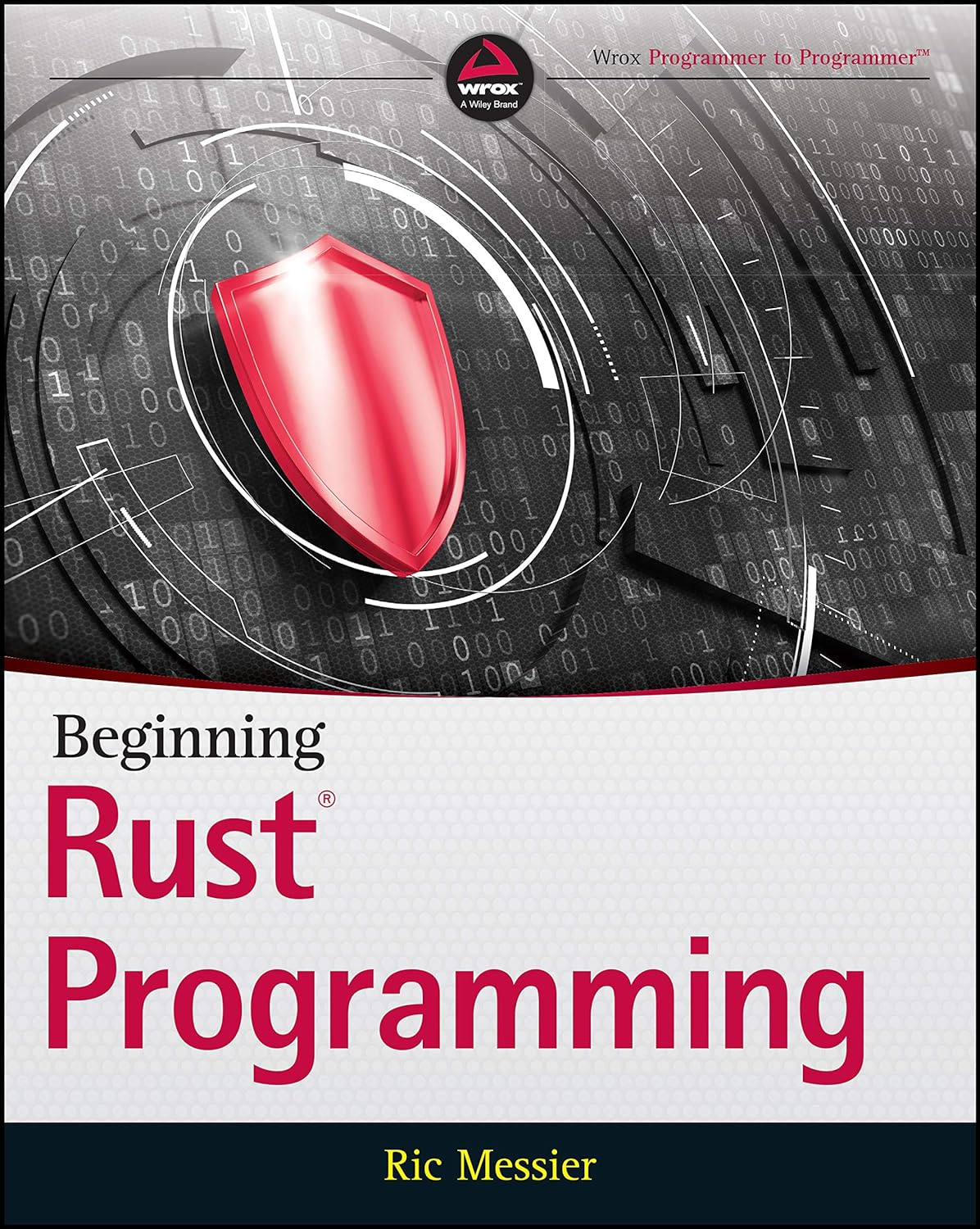
Автор: Messier Ric
Дата выхода: 2021
Издательство: John Wiley & Sons, Inc.
Количество страниц: 663
Размер файла: 3,7 МБ
Тип файла: PDF
Добавил: codelibs
Проверить на вирусы Дополнительные материалыTITLE PAGE....10
INTRODUCTION....11
OBTAINING RUST....12
GETTING THE SOURCE CODE....14
WHAT YOU WILL LEARN....14
PROVIDING FEEDBACK....19
1 Game of Life: The Basics....20
GAME OF LIFE: THE PROGRAM....21
STARTING WITH CARGO....23
PUTTING THE PIECES TOGETHER....25
GENERATING THE GAME GRID....29
DISSECTING MAIN....30
LOOKING AT MORE FUNCTION FUNCTIONS....43
COMPILING PROGRAMS....53
SUMMARY....56
ADDITIONAL RESOURCES....58
2 Extended Life....60
UNDERSTANDING OWNERSHIP....61
EXTENDING LIFE....64
READING FROM FILES....78
OUTPUTTING TO THE TERMINAL....85
SUMMARY....90
ADDITIONAL RESOURCES....92
3 Building a Library....94
REFERENCES....95
FIRST PASS....100
SECOND PASS....116
SUMMARY....125
ADDITIONAL RESOURCES....127
4 Hangman....128
OUR DATA....133
READING FILES AND SELECTING WORDS....148
THE REST OF THE STORY....157
SUMMARY....164
ADDITIONAL RESOURCES....166
5 In Concurrence....167
THE DINING PHILOSOPHERS....169
THE MAIN EVENT....180
THREADING IN THE MAIN....191
SUMMARY....198
ADDITIONAL RESOURCES....200
6 Clients and Servers....201
PLANNING....203
NETWORK PROGRAMMING....206
RUST TCP SERVER....218
SUMMARY....230
ADDITIONAL RESOURCES....232
7 Client-Side Applications....233
ENCRYPTION....235
REMOTE ACCESS CLIENT....255
SUMMARY....269
ADDITIONAL RESOURCES....271
8 Going Relational....273
APPLICATION ARCHITECTURES....274
DATABASES....283
WRITING A DATABASE PROGRAM....292
SUMMARY....311
ADDITIONAL RESOURCES....314
9 No(SQL) Going....315
ASSERTIONS....316
NOSQL....328
WORKING WITH MONGODB....334
SUMMARY....352
ADDITIONAL RESOURCES....354
10 Web Communications....355
STYLE GUIDES....356
HYPERTEXT TRANSFER PROTOCOL....360
CLIENT COMMUNICATION....378
SUMMARY....391
ADDITIONAL RESOURCES....393
11 Web Server....394
OFFENSIVE VS. DEFENSIVE PROGRAMMING....395
WEB APPLICATION COMMUNICATIONS....399
RUST ROCKET....417
SUMMARY....426
ADDITIONAL RESOURCES....428
12 Getting to the System....430
EXTENDING FUNCTIONALITY....432
WINDOWS REGISTRY....441
SYSTEM INFORMATION WITH RUST....458
PERSISTENCE (FOR FUN)....467
SUMMARY....469
ADDITIONAL RESOURCES....472
13 Device Programming....474
LOGGING....475
WORKING WITH RASPBERRY PI....497
SUMMARY....519
ADDITIONAL RESOURCES....521
14 Collecting Stuff....523
ARRAYS AND VECTORS....524
LINKED LISTS....536
SEARCH TREES....559
SUMMARY....567
ADDITIONAL RESOURCES....569
15 Odds and Sods....571
UNIT TESTING....572
RECURSION....591
MACHINE LEARNING....598
SUMMARY....610
ADDITIONAL RESOURCES....612
INDEX....613
COPYRIGHT....659
ABOUT THE AUTHOR....660
ABOUT THE TECHNICAL EDITOR....661
ACKNOWLEDGMENTS....662
END USER LICENSE AGREEMENT....663
Save me from another “hello, world” book. Don’t make me have to skim or skip through a half dozen chapters before I can get to something that’s going to be useful to me. Or you, in this case. I can’t tell you the number of programming books I’ve purchased over the decades, hoping to actually learn the language, only to end up just not using the book because it wasn’t presented in a way that made a lot of sense to me. Instead of a dry explanation of how the language is constructed so you can try to put it all together in meaningful ways yourself, the purpose of this book is to jump straight into writing hopefully interesting or useful programs. Once we have the program, we can take a look at how it’s constructed. You’ll be learning by doing—or learning by example, if you prefer. I hope you’ll find this a more useful and practical way of learning Rust.
Rust is an interesting language, as it turns out. Like so many other languages, it claims a C-like syntax, which is roughly correct but misses out on many important elements. Where Rust really shines is where C has introduced bad behavior in programming practices. This is more apparent as more have been using C as a language. Where C provides you with the gun and the bullets to shoot yourself in the foot, Rust provides you with necessary protections to keep you from injuring yourself or, from the perspective of the application, keeps the application from crashing. Rust is focused on protecting the memory space of the program, in part to provide a better ability for concurrent programming. After all, Rust is considered to be a systems programming language, meaning it is intended for applications that are lower level than those that a user directly interacts with.
In addition to protections provided to the programmer, Rust has a reasonably active community that can be used not only for support but also to get additional functionality for your programs. There are a lot of third-party libraries. These libraries can make your life easier by introducing you to functionality without you needing to write it yourself.
The idea behind this book is to introduce you to Rust in context, rather than via snippets that, by themselves, don’t work. You need all the surround to fully understand what is happening in the program. You’ll find this out when you are looking at example code sometimes. This is true with the Rust documentation: it’s like you need to fully understand the language to understand the examples you are looking at. This book doesn’t take that approach. It assumes that you don’t know the language, so every line in every program is explained in as much detail as is necessary to pull it all apart, since Rust can be a dense language in some ways. This means single lines can pack a lot of meaning and functionality.
The one thing this book does not assume, though, is that you are coming to programming completely fresh. You will see examples for the programs written in Rust also presented in other programming languages. This may be helpful if you come from another language like C or Python, for instance, but want to learn Rust. Seeing the approach in a language you know before translating it into Rust may be beneficial. If you don’t know those other languages, you can skip through those examples and jump to the explanation of how to write a program for the problem under discussion in Rust. You can still compare the other languages to Rust as you are going through so you can better understand Rust and how it is different from other languages.


